
Admissibility: The Layer Beneath Love, Reason, and Law
Love, reason, and law each claim authority over judgment. None authorises itself.

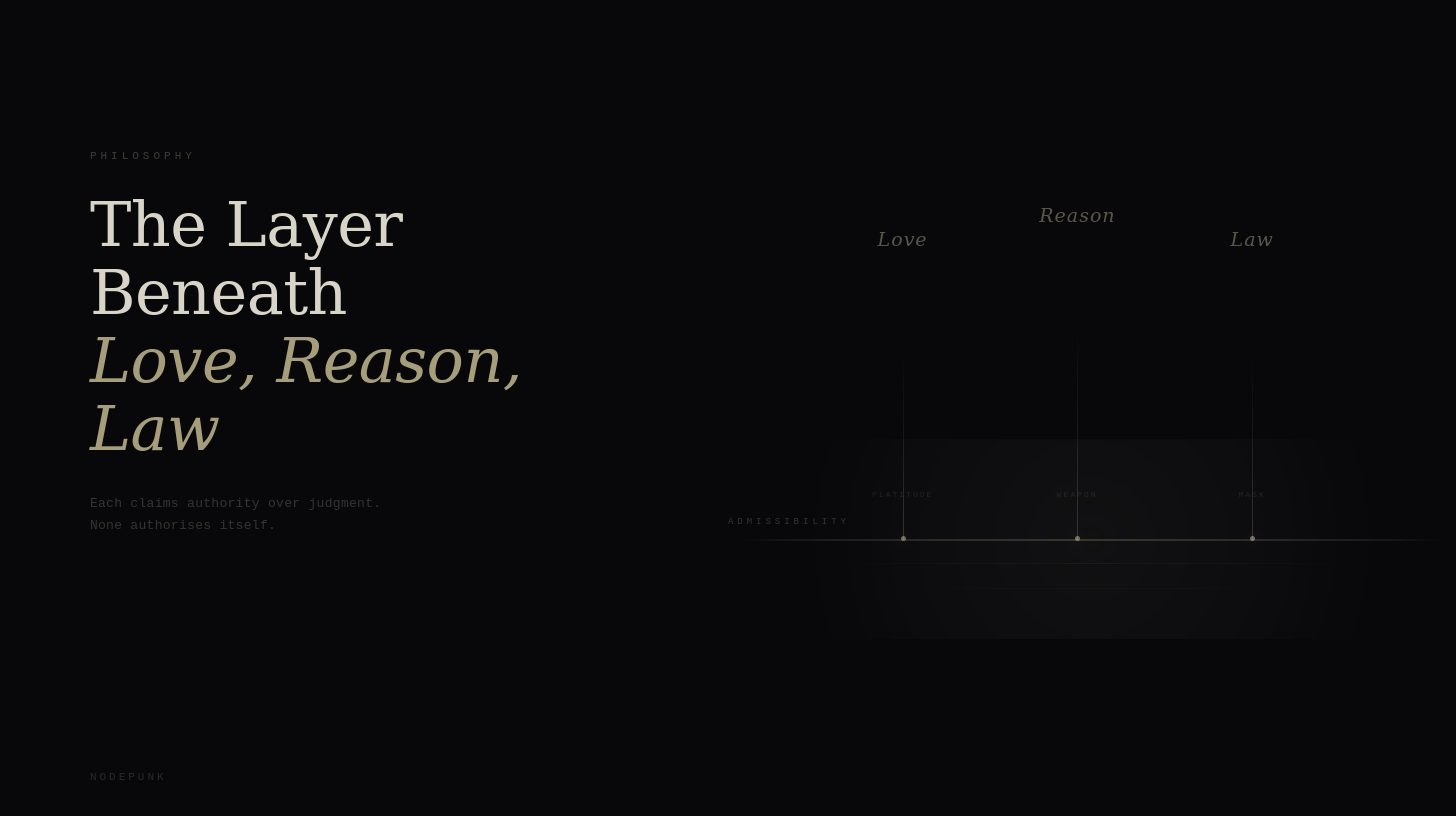
Ask people what matters most and many will say love. Engage them intellectually and the governing language shifts: reason, logic, facts, truth. Both moves are understandable. Love may be the highest value, reason the recognised instrument of judgment, truth the constraint that keeps judgment from fantasy. But none of them is self-authorising. That is the gap admissibility fills.
By admissibility I do not mean legal admissibility alone, nor the general habit of asking questions. I mean the prior condition that decides whether a claimed appeal is entitled to enter judgment at all. An appeal can invoke a name without having earned the standing the name carries. Admissibility is what the appeal must pay before the name does any work.
A person cannot say I did it out of love and thereby make the act loving. Control can call itself love. Possession can call itself care. Projection can call itself concern. Sentimentality can call itself compassion. Cruelty can dress in love’s language and pass, for a while, as love. So the appeal to love must become admissible before it governs anything.
Does it preserve the beloved? Does it respect agency? Does it stay truthful? Does it survive consequence? Or is it fear, guilt, appetite, dependency, or self-exemption wearing love’s name? The questions are not decoration. They are the toll.
Reason is no different. A person cannot invoke facts, logic, or truth and thereby make a position authoritative. Facts can be selected. Logic can be valid in form and irrelevant in matter. Truth can be weaponised. Reason can be used to conceal context, consequence, or standing. The invocation is not the warrant.
So the deeper structure is not love against reason, or reason against love. Love may motivate, reason may justify, truth may constrain — but admissibility decides whether any of them is validly in play. It is not the enemy of love, reason, truth, or law. It is what protects each of them from counterfeit invocation.
Admissibility is not the same as interrogation, and it should not be mistaken for the slogans interrogation tends to harden into. We should ask questions. We should challenge assumptions. Fine — but that is not yet admissibility. Questioning opens the field; admissibility governs what may enter it. Just asking questions can be evasive, theatrical, a way of never reaching judgment. It is not a discipline. Admissibility is stricter: it requires standing, relevance, warrant, scope, coherence, consequence, and integrity. It does not ask whether something can be questioned. It asks whether what is offered has earned the right to function as authority.
The same applies to rule of law. In jurisprudence the phrase can be precise and serious. In public rhetoric it often settles a matter it has not examined, concealing the prior questions: what is being allowed to count as law, as evidence, as authority, standing, procedure, exception, remedy? Without admissibility, rule of law preserves the appearance of legality while leaving the conditions of valid authority untouched. The phrase meant to guard against arbitrariness becomes, unexamined, a legitimating formula — law’s own platitude.
A single sentence holds the whole. Love names value, reason names instrument, law names public form, admissibility names the certification condition. Platitude, weapon, and mask name the three ways each fails — by going slack, by being turned on someone, by being worn as a disguise.
One condition is load-bearing here and should be named rather than smuggled. Admissibility must survive its own test. Applied without criteria, without charity, without awareness of consequence, it becomes exactly the thing it was built to expose — a mask, a way of ruling appeals out by fiat while claiming to certify them. A standard that cannot pass itself certifies nothing. So the test is turned, first, on the one applying it.
None of this is anti-law, anti-reason, or anti-love. It is anti-counterfeit. Every counterfeit borrows a noble name; admissibility is the toll the counterfeit cannot pay. Love may be the highest value, reason the recognised instrument, law the public form. Each still has to become admissible before it governs. No appeal authorises itself. That is what admissibility is for.